The History of Infant Feeding
by Mary Ferrari
“For most of human history feeding an infant when the mother could not breastfeed depended on another woman’s milk. The twentieth century eventually brought a growing recognition that feeding choices could have consequences beyond immediate nutrition. These findings helped shift the discussion from whether formula could provide adequate nourishment to a broader question: what biological functions might be missing when human milk is replaced?”
For most of human history feeding an infant when the mother could not breastfeed depended on another woman’s milk. Long before commercial formula or modern bottles existed, wet nursing was the primary alternative to maternal breastfeeding. Historical evidence places the practice as far back as 2000 BC, and it remained an established profession for centuries. The development of artificial feeding eventually transformed this system, but the transition was gradual and shaped by changes in medicine, technology, social attitudes, economics, and eventually commercial interests.
Wet nursing was not just an informal arrangement, in many societies it became a regulated profession, particularly among wealthy families who employed women to nurse their children. During the Roman Empire, contracts specified the length of nursing, compensation, clothing, and other responsibilities. Medical writers also discussed the qualities of an appropriate wet nurse, including her health, recent childbirth, temperament, and the perceived quality of her milk. Attitudes toward the practice changed over time and during the Middle Ages and Renaissance, concerns emerged that a wet nurse might transmit physical or behavioral characteristics to the infant. At the same time, breastfeeding by the biological mother increasingly became associated with maternal responsibility and virtue.
Social class also influenced how infants were fed as aristocratic women in parts of Europe sometimes avoided breastfeeding because it was considered unfashionable, interfered with clothing and social activities, or was believed to affect their figures. The wives of merchants, lawyers, and doctors also did not breastfeed because it was less expensive to employ a wet nurse than it was to hire a woman to run their husband’s business or take care of the household in their place. Among working families, economic pressures eventually became an even more important factor as the Industrial Revolution moved populations into cities, increased the need for women to earn wages, and made caring for an infant while working increasingly difficult. Wet nursing consequently shifted from an occupation serving wealthy households to one increasingly associated with poorer women and by the beginning of the twentieth century, the once widespread profession had largely disappeared.
The feeding bottle provided another important turning point. Although vessels for feeding infants had existed for thousands of years, early devices were difficult to clean and could harbor dangerous bacteria. Archaeological evidence shows that ancient vessels contained residues of animal milk, demonstrating that artificial feeding is not a modern invention. Medieval and early modern feeding devices included animal horns, ceramic containers, wooden vessels, metal pots, cloth, and sponges and their practical limitations made artificial feeding hazardous. During the early nineteenth century, contamination of feeding equipment, combined with inadequate milk storage and sterilization, contributed to extremely high mortality among artificially fed infants.
Even when bottles could be cleaned safely, the milk itself posed serious risks. During this time, milk transported into growing cities was often heavily contaminated. A series of exposés in Frank Leslie’s Illustrated Newspaper in 1858 revealed the dangers of New York’s “swill milk” trade, where cows were kept in filthy conditions and fed waste products from liquor distilleries. The resulting outcry led to milk becoming a major public health concern. The dangers of artificial feeding were reflected in the staggering infant mortality of the period and the combination of dirty feeding devices, poor milk storage, and inadequate sterilization was associated with the death of one third of artificially fed infants during their first year of life.
The Industrial Revolution also brought improvements in both bottle design and food preservation. Glass bottles became increasingly practical, while improved nipples and better household refrigeration gradually reduced some of the dangers associated with artificial feeding.
The initial steps toward modern infant bottle-feeding took shape in 1841 when Dr. Charles M. Windship patented the first glass nursing bottle in the United States, an invention that laid the groundwork for flexible feeding methods. This mid-19th-century design relied on a long rubber tube connected to an early iteration of a rubber nipple, allowing infants to feed without constant adult assistance. Though this development provided a softer alternative to rigid materials like pewter, bone, or wood, early crude rubber possessed a pungent odor, warped easily in boiling water, and trapped deadly bacteria inside the uncleansable tubing, a fatal design flaw that was not fully resolved until Elijah Pratt patented a standalone vulcanized India-rubber nipple in 1845.
At the same time, animal milk particularly cow’s milk became a major substitute for human milk. By the eighteenth century, scientists were comparing the chemical composition of human and animal milk and recognizing that they were not nutritionally identical. This led researchers to search for ways of modifying nonhuman milk so that it would more closely resemble human milk.
Commercial infant foods emerged from this scientific and technological environment. In 1865, Justus von Liebig developed and marketed an infant food made from cow’s milk, wheat and malt flour, and potassium bicarbonate. Other commercial products soon followed. Henri Nestlé, a German-born pharmacist, founded his company in 1866 and revolutionized infant nutrition in 1867 by introducing Farine Lactée (“Milk Flour”) in Vevey, Switzerland. Developed to combat high infant mortality rates, this breakthrough product gained rapid international popularity and forming the foundation of the modern Nestle brand and by the 1870s the formula is sold across five continents. By 1883, the historical review reports that 27 patented infant-food brands existed, many consisting largely of carbohydrates intended to be added to milk. Products associated with companies such as Nestlé, Horlick’s, Mellin, and others became increasingly recognizable to consumers.
Another important scientific advancement of the 19th century was food preservation. In 1810,Nicholas Appert developed a technique to sterilize food in sealed containers. His development was followed by the invention of evaporated milk, which was patented in 1835 by William Newton. In 1853, Texan Gale Borden added sugar to the evaporated milk, canned the substance, and sold it as Eagle Brand Condensed Milk, which became a popular infant food. In 1885, John B. Myerling developed an unsweetened condensed milk, labeling it as ‘‘evaporated milk.’’ Myerling’s product was also a popular choice for infant feeding and was highly recommended by pediatricians from the 1930s to the 1940s.
The rise of commercial feeding was not driven by formulation alone. Advertising became a powerful force in shaping public perception. As manufacturers refined their products, they increasingly promoted them as convenient, reliable alternatives to breastfeeding. Formula companies also cultivated relationships with physicians. In the United States, the American Medical Association established a Committee on Foods in 1929 to evaluate the safety and quality of infant-food composition. Advertising restrictions introduced in the early 1930s limited direct solicitation of nonmedical audiences, while simultaneously creating a close relationship between manufacturers and medical professionals. By the 1940s and 1950s, formula had become widely accepted by both physicians and consumers as a safe and modern substitute for breastmilk. Breastfeeding subsequently declined for decades.
The history also demonstrates why the nutritional comparison between human milk and manufactured substitutes is more complicated than simply matching calories, protein, fat, carbohydrates, vitamins, and minerals. Human milk is a dynamic biological system, whereas traditional formula was designed as a relatively fixed nutritional product. The paper notes that formula does not change composition as an infant develops, while breastmilk changes over time. Researchers therefore became increasingly interested not merely in supplying nutrients, but in understanding how infant feeding influences digestion, immunity, allergy, metabolism, and later health.
The twentieth century eventually brought a growing recognition that feeding choices could have consequences beyond immediate nutrition. The historical review discusses research associating breastfeeding with lower rates of several childhood conditions, including atopy, diabetes, and obesity. It also describes evidence suggesting that longer breastfeeding was associated with reduced risk of certain allergic outcomes and childhood overweight. These findings helped shift the discussion from whether formula could provide adequate nourishment to a broader question: what biological functions might be missing when human milk is replaced?
This question became particularly important as researchers learned more about the complexity of human milk. What earlier generations viewed primarily as nourishment is now understood to contain a diverse collection of biologically active components that interact with the developing gastrointestinal tract, immune system, and microbial environment. The historical progression from wet nursing to animal milk, bottles, preserved foods, and increasingly sophisticated formulas represents more than a technological story and is the history of an evolving understanding of what an infant actually needs.
By the end of the twentieth century, regulation had become another major part of that story. The Infant Formula Act of 1980 established federal oversight of formula quality in the United States, while international controversy surrounding formula marketing contributed to the development of the World Health Organization’s International Code of Marketing of Breast-milk Substitutes. The historical record shows that infant feeding has never been determined by biology alone. Cultural expectations, economic circumstances, scientific discoveries, technology, advertising, medical practice, and public policy have all influenced how societies feed their youngest members.
The enduring lesson is that replacing human milk is fundamentally different from simply replacing a food. The history of infant feeding shows a progression from finding an alternative source of milk to attempting to reproduce the nutritional and biological functions of human milk. Modern research into human milk oligosaccharides, immune factors, microbiota, and other components continues that centuries old effort but with a much deeper understanding of what makes human milk biologically distinctive.
Source:
2009
2018
Henri Nestlé: the man behind the global enterprise
2014
Historic Records on the Commercial Production of Infant Formula
2013
A Brief History of 7 Baby Basics
Milk: Life, Death, and Women’s Work
GLOBAL BREASTFEEDING SCORECARD 2024
2018
Fourteen peer-reviewed studies published between 1926 and 2017 and reporting measurements from healthy, breastfed infants were found and included. A least squares linear regression model revealed a strong positive trend with a high association between the publication year and fecal pH These data suggest that the mean fecal pH of breastfed infants has increased from about 5.0 in 1926 to 6.5 in recent years. Given our previous finding linking fecal pH to Bifidobacterium abundance and reported differences in Bifidobacterium abundance across populations today, this longitudinal change is consistent with a generational loss of Bifidobacterium in developed countries, most notably among infants born after 1980.
ARE THERE HEALTH IMPLICATIONS TO THIS CHANGE?
There is clear evidence that the infant gut microbiome has important long-term health implications, and perturbations of the microbiome composition may lead to chronic inflammation and immune-mediated diseases. These data highlight an increase in infant intestinal dysbiosis.
Malnutrition is the leading cause of death worldwide in children under the age of five, and is the focus of the first World Health Organization (WHO) Millennium Development Goal (2017).
- breastfeeding
- food
- and water security
are major protective factors against malnutrition and critical factors in the maturation of healthy gut microbiota, characterized by a transient bifidobacterial bloom before a global rise in anaerobes. Early depletion in gut Bifidobacterium longum, a typical maternal probiotic, known to inhibit pathogens, represents the first step in gut microbiota alteration associated with severe acute malnutrition (SAM). Later, the absence of the Healthy Mature Anaerobic Gut Microbiota (HMAGM) leads to deficient energy harvest, vitamin biosynthesis and immune protection, and is associated with diarrhea, malabsorption and systemic invasion by microbial pathogens. A therapeutic diet and infection treatment may be unable to restore bifidobacteria and HMAGM. Besides refeeding and antibiotics, future trials including non-toxic missing microbes and nutrients necessary to restore bifidobacteria and HMAGM, including prebiotics and antioxidants, are warranted in children with severe or refractory disease.
The path to discovering and synthesizing HMOs was a century-long detective story driven by a medical mystery: Why did breastfed infants survive deadly diseases far better than bottle-fed infants?
The 1880s: The Bacterial Clue
In 1886, Austrian pediatrician Theodor Escherich noticed that breastfed babies had completely different gut bacteria than bottle-fed babies. Around the same time, French chemist Eschbach discovered that human milk contained a strange, unknown carbohydrate fraction that didn’t exist in cow’s milk.
The 1930s: Isolating “Gynolactose”
Chemists finally managed to isolate this mysterious carbohydrate cluster from human milk. Not knowing what individual sugars made it up, they simply named the entire mixture “Gynolactose” (woman’s milk sugar).
The 1950s: The “Bifidus Factor” Breakthrough
Pediatrician Paul György and Nobel Prize-winning chemist Richard Kuhn teamed up to figure out what Gynolactose actually did. They discovered it acted as a targeted fertilizer, feeding healthy Bifidobacterium in the infant gut while leaving harmful bacteria to starve. They renamed these sugars the “Bifidus Factor”. By the mid-1950s, they mapped the exact chemical structures, realizing these were complex chains of oligosaccharides.
1979: The First Artificial HMO
Once the chemical structures were mapped, laboratory chemists set out to build them without a human body. In 1979, scientists achieved the first recorded pure chemical synthesis of an HMO, constructing a structure called Lacto-N-tetraose (LNT) entirely from scratch in a lab.
1979- present – Companies like Glycom first scaled….
2016 – World Health Organization, UNICEF
By 2016, over 135 countries had implemented parts of the original WHO Code into national legislation to ban public infant formula advertising.
The WHO code bans any form of promotion of baby formula, including the advertising and the distribution of gifts or free samples. Manufacturers are instructed not to champion the health benefits or depict images that idealize the use of baby formula.
2017 – HMO’s approved for Infant formula.
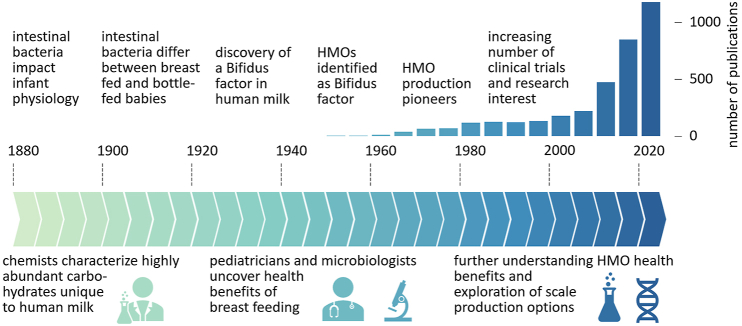
Häsler R, Mikš MH, Bajic D, Soyyilmaz B, Bendik I, van Buul VJ, Steinert RE, Rehman A. Human Milk Oligosaccharides Modulating Inflammation in Infants, Adults, and Older Individuals-From Concepts to Applications. Adv Nutr. 2025 Jun;16(6):100433. doi: 10.1016/j.advnut.2025.100433. Epub 2025 Apr 24. PMID: 40287068; PMCID: PMC12148444.
Henri Nestlé and the Origins of a Global Food Company:
Henri Nestlé’s story belongs to the larger transformation of infant feeding during the nineteenth century, when advances in food preservation, chemistry, manufacturing, and transportation made commercially produced infant foods possible. Henri Nestlé, a Swiss pharmacist and entrepreneur, developed an infant food that combined milk with other ingredients and was marketed as an alternative for infants who could not be breastfed. His work emerged during a period when scientists and manufacturers were actively searching for ways to create practical substitutes for human milk.
Nestlé’s early product became part of a rapidly expanding commercial infant-food industry. The historical review A History of Infant Feeding identifies Nestlé’s Food among the branded infant foods being sold in the late nineteenth century. These products reflected a major change in infant nutrition: feeding was moving from the household, wet nurse, or local milk supply toward standardized products manufactured and marketed on an increasingly large scale.
Henri Nestlé’s significance extends beyond the individual product he created and his enterprise became part of the industrialization of food itself, demonstrating how scientific knowledge, manufacturing, preservation, branding, and international commerce could transform something as fundamental as infant feeding into a global business.
For the broader story of his life and the origins of the company, see the Swiss government’s historical feature, “Henri Nestlé: The Man Behind the Global Enterprise.”
Where are we today?
Although the WHO discourages bottle milk feeding, the worldwide prevalence of 59% in children receiving formula milk instead of breast milk in their first year of life illustrates the potential impact of this risk factor. In contrast to formula milk, mother’s milk reduces the risk of NEC by factors 6–10, as shown in a multicenter cohort study of low-birth-weight infants. In animal models, this effect has been attributed to HMOs and extracellular vesicles in human milk. Pathogens are highly relevant for many severe conditions, such as infectious diarrhea, respiratory tract infections, and sepsis, which manifest in early childhood. In addition, diarrhea is the result of pathogens adhering to the mucosal, with subsequent dissemination, colonization, and invasion (for example, E. coli, Helicobacter jejuni, Shigella strains, Vibrio cholerae, and Salmonella species).
Child-feeding practices, particularly breastfeeding, significantly impact children’s health and survival. However, bottle feeding, although historically practiced, presents numerous disadvantages affecting optimal child nutrition and health. Despite World Health Organisation and The United Nations Children’s Fund recommendations against bottle feeding, it remains prevalent globally, affecting roughly 59% of infants worldwide and 85% in Australia by 5 months of age.
Historically leading nations with high exclusive breastfeeding rates include countries like Rwanda, Burundi, and Sri Lanka, which record rates exceeding 80%.
Rates vary widely—for instance, exclusive breastfeeding under six months sits at 43% in Latin America and the Caribbean, but drops to 27% in North America.
Of the 106 countries that have updated their data on exclusive breastfeeding since 2017 when the Global Breastfeeding Scorecard was first published, 75 countries reported an increase in breastfeeding rates. Notably, 23 of these countries saw an increase of more than 10 percentage points. While this progress is commendable, 29 countries experienced declines in breastfeeding rates during this time, with six of them recording decreases of over 10 percentage points.